
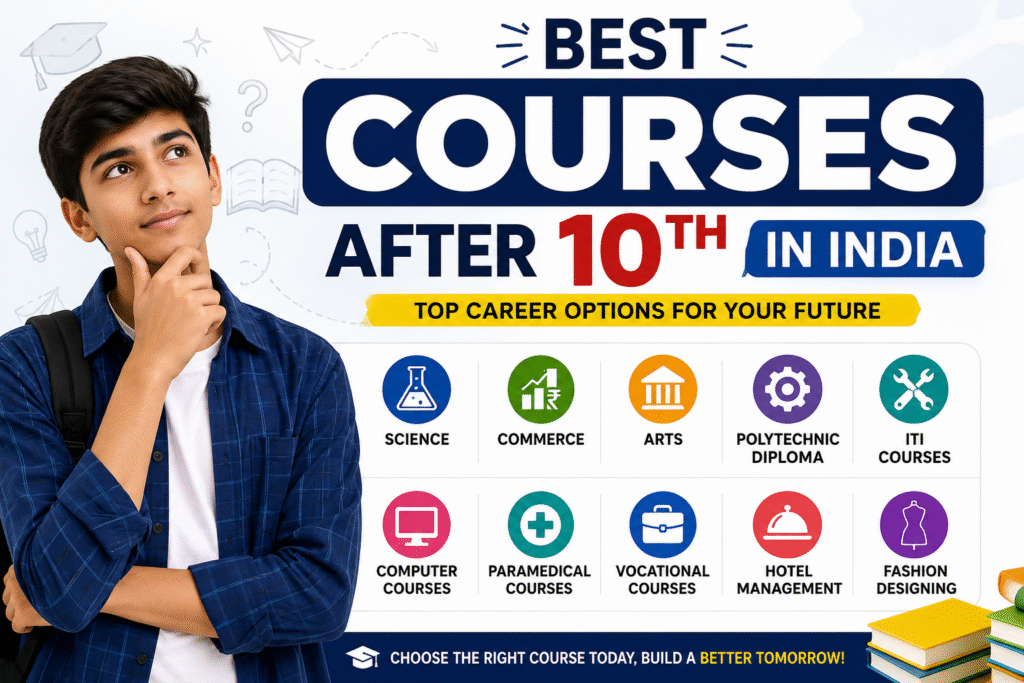
Choosing the right course after Class 10 is one of the first important career decisions for students. After passing the 10th board examination, students in India have several options, including Class 11 in Science, Commerce or Arts, diploma courses, ITI programs, vocational training and skill-based courses.
However, the best course after 10th depends on your interests, academic strengths, career goals, budget and the type of job or further education you want to pursue.
In this guide, we explain the best courses after 10th in India, including eligibility, course duration, career opportunities and important factors to consider before choosing a path.
Table of Contents
Quick Overview of Courses After 10th
| Course Type | Typical Duration | Suitable For |
|---|---|---|
| Class 11 Science | 2 Years | Engineering, medical, research and technology careers |
| Class 11 Commerce | 2 Years | Finance, business, accounting and management |
| Class 11 Arts/Humanities | 2 Years | Civil services, law, media, teaching and social sciences |
| Polytechnic Diploma | 3 Years | Technical and engineering careers |
| ITI Courses | 6 Months–2 Years | Trade and skill-based careers |
| Paramedical Courses | Varies | Healthcare and allied health careers |
| Computer Courses | 3 Months–3 Years | IT and technology skills |
| Vocational Courses | Varies | Practical and job-oriented skills |
1. Science Stream After 10th
The Science stream is a popular choice for students interested in mathematics, biology, technology and scientific subjects.
Students can generally choose combinations based on their school and education board, such as:
- Physics, Chemistry and Mathematics
- Physics, Chemistry and Biology
- Physics, Chemistry, Mathematics and Biology
Career Options After Science
Science can lead to careers in:
- Engineering
- Medicine and healthcare
- Pharmacy
- Biotechnology
- Computer science
- Architecture
- Research
- Defence services
- Data and technology-related fields
Who Should Choose Science?
Science may be suitable if you enjoy subjects such as Mathematics, Physics, Chemistry or Biology and are comfortable with analytical and scientific learning.
2. Commerce Stream After 10th
Commerce is suitable for students interested in business, finance, economics, accounting and management.
Common subjects may include:
- Accountancy
- Business Studies
- Economics
- Mathematics or Applied Mathematics
- Entrepreneurship
Career Options After Commerce
After completing Class 12 and higher education, students can explore careers in:
- Chartered Accountancy
- Company Secretary
- Cost and Management Accounting
- Banking
- Finance
- Investment analysis
- Business management
- Entrepreneurship
- Taxation
Who Should Choose Commerce?
Commerce can be a good option for students interested in money, business operations, accounting and economics.
3. Arts or Humanities After 10th
The Arts or Humanities stream offers a wide range of academic and career opportunities.
Common subjects may include:
- History
- Political Science
- Geography
- Psychology
- Sociology
- Economics
- English
- Fine Arts
Career Options After Arts
Students can later explore careers in:
- Civil services
- Law
- Journalism
- Teaching
- Psychology
- Social work
- Public policy
- Design
- Content and media
Arts is no longer limited to traditional career paths. Many professional courses and competitive examinations are open to students from the Humanities background.
4. Polytechnic Diploma Courses After 10th
A Polytechnic Diploma is a technical education option for students who want practical engineering knowledge after Class 10.
Popular diploma specializations include:
- Diploma in Mechanical Engineering
- Diploma in Civil Engineering
- Diploma in Electrical Engineering
- Diploma in Computer Engineering
- Diploma in Automobile Engineering
- Diploma in Electronics Engineering
Duration
Many diploma programs are approximately three years, although duration and eligibility can vary by institution and state.
Career Opportunities
After completing a diploma, students may:
- Apply for technical jobs
- Continue with higher education
- Explore lateral entry opportunities where applicable
- Develop specialized technical skills
5. ITI Courses After 10th
Industrial Training Institute (ITI) courses focus on practical and trade-based skills.
Popular ITI trades include:
- Electrician
- Fitter
- Welder
- Mechanic
- Plumber
- Computer Operator
- Draughtsman
- Electronics Mechanic
- Refrigeration and Air Conditioning Technician
Course Duration
ITI courses can range from approximately 6 months to 2 years, depending on the trade and program.
Career Opportunities
ITI graduates may find opportunities in:
- Manufacturing
- Construction
- Maintenance
- Automotive services
- Electrical work
- Government and private sector organizations
- Self-employment
6. Computer Courses After 10th
Students interested in technology can start building computer skills after Class 10.
Popular options include:
- Computer fundamentals
- Programming
- Web development
- Graphic design
- Digital marketing
- Data analytics
- Cybersecurity fundamentals
- Office productivity tools
The duration of these courses can vary significantly depending on the institution and course level.
Important Tip
Instead of selecting a course only because it promises a high salary, check:
- Whether the course provides practical skills.
- Whether the curriculum is updated.
- Whether the institution is credible.
- Whether the skill matches your interests.
- Whether there is demand for the skill.
7. Paramedical Courses After 10th
Some institutions offer healthcare and allied health programs after Class 10.
Depending on eligibility requirements, students may find courses related to:
- Medical laboratory technology
- Healthcare assistance
- Nursing assistance
- X-ray and imaging assistance
- Emergency care assistance
Before enrolling, always check the recognition, eligibility criteria and regulatory requirements of the institution and program.
8. Vocational Courses After 10th
Vocational education focuses on practical skills that can support employment or self-employment.
Popular vocational areas include:
- Fashion designing
- Beauty and wellness
- Photography
- Animation
- Video editing
- Graphic design
- Hotel management
- Tourism
- Retail management
- Food production
These courses can be useful for students who prefer practical learning over traditional academic education.
9. Diploma in Hotel Management
Students interested in the hospitality industry can explore diploma programs related to hotel and hospitality management.
Career opportunities may include:
- Hotels and resorts
- Restaurants
- Tourism companies
- Event management
- Food and beverage services
The exact eligibility and duration depend on the institution.
10. Diploma in Fashion Designing
Fashion designing can be suitable for creative students interested in clothing, textiles and design.
Students may learn about:
- Fashion illustration
- Textile basics
- Pattern making
- Garment construction
- Fashion trends
Career paths can include employment with fashion brands, boutiques, manufacturing companies or self-employment.
11. Graphic Design and Animation Courses
Creative students interested in digital media can consider courses in:
- Graphic design
- 2D animation
- 3D animation
- Video editing
- Motion graphics
- UI and visual design fundamentals
Building a strong portfolio is often important in creative industries.
12. Government Job Preparation Along With Further Studies
Students should be cautious about stopping their education solely to prepare for a government job immediately after Class 10.
Instead, students can continue their education through:
- Class 11 and Class 12
- Polytechnic
- ITI
- Vocational education
They can then explore government recruitment opportunities based on the eligibility requirements of individual examinations.
Always check the official notification before applying for any government job.
How to Choose the Best Course After 10th
There is no single course that is best for every student. Consider the following factors before making a decision.
1. Identify Your Interests
Ask yourself:
- Which subjects do I enjoy?
- Do I prefer practical or theoretical learning?
- Do I enjoy technology, business, creativity or healthcare?
2. Understand Your Strengths
Your marks can provide useful information, but they should not be the only factor.
Consider your:
- Subject knowledge
- Communication skills
- Analytical ability
- Creativity
- Technical interest
3. Research Career Opportunities
Before selecting a course, understand:
- What skills will you learn?
- What higher education options are available?
- What jobs can you pursue?
- What qualifications are required?
4. Check Course Recognition
Always verify:
- Institution recognition
- Course approval
- Eligibility requirements
- Total fees
- Placement claims
Avoid joining an institute based only on advertisements or unrealistic salary promises.
Which Is the Best Course After 10th?
The answer depends on your career goal.
| Your Interest | Possible Path |
|---|---|
| Engineering and Technology | Science or Polytechnic Diploma |
| Medicine and Healthcare | Science with Biology and relevant higher education |
| Finance and Business | Commerce |
| Civil Services and Social Sciences | Arts/Humanities |
| Technical Trades | ITI |
| Practical Job Skills | Vocational Courses |
| Computer and Digital Skills | Computer and Technology Courses |
| Creative Careers | Design, Animation or Fashion Courses |
The best choice is one that matches your interests, abilities and long-term career goals.
Frequently Asked Questions
Which course is best after 10th for a high salary?
There is no guaranteed high-salary course immediately after Class 10. Long-term income depends on factors such as skills, qualifications, experience, location and industry demand. Students can consider fields such as technology, engineering, healthcare, finance and skilled trades based on their interests and abilities.
Can I do a diploma after 10th?
Yes, many institutions offer diploma and Polytechnic programs after Class 10. Eligibility requirements, entrance procedures and course duration may vary depending on the institution and state.
Is ITI better than Class 11?
Neither option is universally better. ITI may be suitable for students who want practical trade skills, while Class 11 and Class 12 can provide a broader academic path and access to various higher education options.
Which stream should I choose after 10th?
Choose Science, Commerce or Arts based on your interests, strengths and future career goals. Avoid choosing a stream only because your friends or relatives recommend it.
Can I get a government job after 10th?
Some government recruitment opportunities may have Class 10 as the minimum educational qualification. However, eligibility varies by recruitment notification. Always verify the latest requirements on the official website of the recruiting organization.
What should I do if I am confused after Class 10?
Start by identifying your interests and strengths. Speak with teachers, career counsellors and professionals, and compare multiple courses before making a decision. Do not rush simply because others have already selected a stream.
Final Thoughts
Choosing the best course after 10th in India is an important decision, but it does not permanently determine your entire career. Students can change direction, learn new skills and pursue different opportunities as they continue their education.
Whether you choose Science, Commerce, Arts, Polytechnic, ITI or a vocational course, focus on building relevant knowledge and practical skills.
Before making your final decision, compare course eligibility, duration, fees, recognition and future opportunities. Choose a path that aligns with your interests and long-term goals rather than following trends or pressure from others.
Continue Exploring Education Guides
Explore more courses, careers, exams, scholarships, skills and student resources.
- SM Meaning in Text: What Does SM Mean in Texting? 2026
- How to Use Previous Year Questions Properly for JEE Preparation
- Every Digital Research Skill That Every Student Should Develop
- Body Sculpting Training: Complete Guide to Choosing a Professional Body Sculpting Course
- The Career Advantages of 500 Hour Yoga Teacher Training in Rishikesh
- Government Jobs After 10th in India: Best Opportunities, Eligibility, Exams and Preparation Guide