
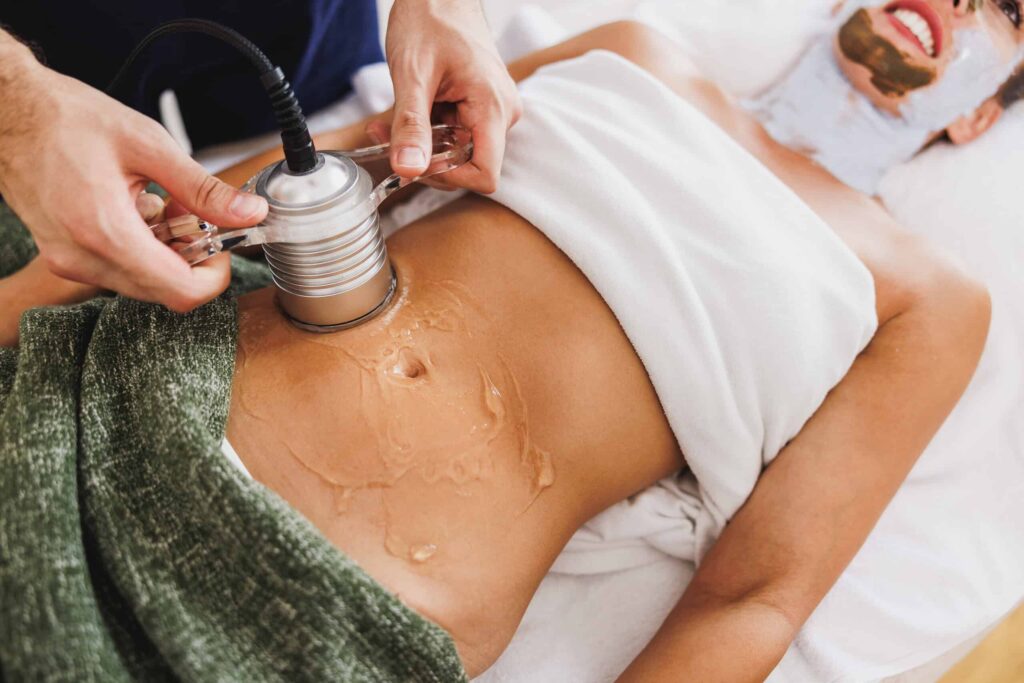
Professional body sculpting training can help beauty and aesthetic practitioners develop the knowledge needed to use modern body contouring equipment safely, confidently and correctly.
With technologies including ultrasonic cavitation, radio frequency, vacuum RF and other non-invasive aesthetic systems now widely available, choosing the right body sculpting course is an important step for anyone planning to introduce machine-based body treatments into their business.
But not every body sculpting course covers the same equipment, and purchasing a machine does not automatically mean that a practitioner understands how to use every function correctly.
Whether you are considering adding cavitation to an existing treatment menu or investing in a multi-function body contouring machine, this guide explains what to look for in body sculpting training, what you should learn and why machine-specific knowledge matters.
Table of Contents
What Is Body Sculpting Training?
Body sculpting training teaches practitioners about non-invasive aesthetic technologies used within professional body contouring treatments.
The exact content of a body sculpting course varies according to the technologies and equipment being covered.
Training may include areas such as:
- Ultrasonic cavitation
- 40K cavitation
- 80K cavitation
- Radio frequency
- Multipolar RF
- Vacuum RF
- Body contouring equipment
- Machine setup and operation
- Treatment parameters
- Contraindications
- Client consultation
- Treatment protocols
- Hygiene and machine maintenance
- Professional aftercare
Before enrolling, always check exactly what the course covers.
A course focusing on cavitation alone is different from a course designed around a multi-function body sculpting machine.
What Is a Body Sculpting Course?
A body sculpting course is designed to provide education relating to non-invasive body contouring treatments and/or the equipment used to perform them.
Courses can be delivered in different ways.
Some are practical classroom-based qualifications, while others are online training programmes, machine-operation courses or supplementary professional education.
This distinction matters.
If you need a particular qualification for insurance purposes, do not assume that every online body sculpting course provides it.
Always check the course status and confirm your insurer’s requirements before purchasing equipment or offering a new treatment commercially.
Why Is Body Sculpting Training Important?
Modern body sculpting machines can incorporate several technologies within one system.
A professional machine might have separate handpieces for cavitation, radio frequency and vacuum treatments.
Understanding how to switch a machine on is therefore only the beginning.
A practitioner also needs to understand what each function does, how the handpieces differ and when a treatment may be unsuitable.
Good body sculpting training should help practitioners understand the equipment rather than simply memorising a sequence of buttons.
This becomes particularly important when moving from a basic machine to a larger 6-in-1, 9-in-1 or 10-in-1 body contouring system.
Body Sculpting Training for Cavitation
Ultrasonic cavitation is one of the most common technologies associated with professional body sculpting.
A cavitation body sculpting course should explain the technology being used and how to operate the relevant cavitation handpiece correctly.
Depending on the machine, this could involve either 40K or 80K cavitation.
Training should cover areas such as:
- Identifying the cavitation handpiece
- Machine setup
- Selecting appropriate settings
- Correct application
- Treatment areas
- Treatment duration
- Appropriate treatment mediums
- Contraindications
- Client consultation
- Cleaning the handpiece
- Machine care
Practitioners should always follow the manufacturer’s instructions for their individual machine.
40K Cavitation Training
A large proportion of professional cavitation equipment uses 40K ultrasonic cavitation.
For this reason, 40K cavitation frequently forms part of body sculpting training.
If you purchase a multi-function 40K machine, machine-specific education can be particularly useful because it allows you to become familiar with the controls, settings and individual handpieces supplied with that system.
Not every 40K cavitation machine is identical.
The interface, power settings, timer controls and additional functions can vary between models.
Training based on the equipment you actually own can therefore be more useful than relying entirely on generic operating information.
80K Cavitation Training
Professional body sculpting equipment is also available with 80K cavitation technology.
If you purchase an 80K machine, your training should relate to the specification of that equipment.
Practitioners should not assume that settings or protocols from one machine can simply be transferred to another.
This applies particularly when changing between different manufacturers, models or ultrasonic frequencies.
Machine-specific instructions should always take priority over generic information found online.
Body Sculpting Training for Radio Frequency
Radio frequency is another major technology found within professional body sculpting machines.
Depending on the equipment, several RF handpieces may be supplied for different applications.
A body sculpting course with RF training should help practitioners identify the relevant handpieces and understand their correct operation.
Training may include:
- RF machine setup
- Handpiece identification
- Treatment parameters
- Appropriate treatment areas
- Application technique
- Contraindications
- Client preparation
- Treatment precautions
- Cleaning and maintenance
If your cavitation machine contains multiple RF handpieces, make sure you understand which handpiece is intended for each application.
Vacuum RF and Body Sculpting Training
Some professional body sculpting machines combine radio frequency with vacuum technology.
Vacuum RF requires its own operational understanding.
The practitioner needs to know how the machine’s suction settings work and how the relevant handpiece should be operated.
This is another reason why a general body sculpting course may not necessarily teach you everything about a specific machine.
If your equipment contains vacuum RF, ensure your training or machine instructions cover that particular function.
Online Body Sculpting Course vs Practical Training
When searching for a body sculpting course, you will find both online and practical options.
Neither should automatically be treated as interchangeable.
Practical training may be appropriate where hands-on assessment or a specific qualification is required.
Online machine training can be extremely useful for learning how a particular piece of equipment is assembled, configured and operated.
The important consideration is what you actually need.
If you already hold suitable practitioner qualifications and purchase a new machine, you may primarily require additional education on the operation of that particular model.
If you are completely new to professional body treatments, your requirements may be significantly broader.
Always confirm your insurer’s requirements before offering treatments commercially.
Machine Training vs Accredited Body Sculpting Training
This distinction is particularly important when comparing courses.
Machine training is designed to teach the setup, functions and operation of specific equipment.
An accredited professional qualification has a different purpose and may include assessment and broader theoretical or practical requirements.
They should not be confused.
At Glow Beauty Case LTD, our machine-specific courses are designed to support customers with the setup and operation of applicable equipment.
Where a course is non-accredited machine training, this is stated accordingly.
It should not be represented as an accredited practitioner qualification.
Practitioners remain responsible for ensuring they hold any training, qualifications and insurance required to perform treatments professionally.
What Should a Body Sculpting Course Cover?
Before purchasing a course, examine its content.
For machine-based treatments, useful areas include:
Machine Setup
You should understand how the machine is assembled and prepared correctly before treatment.
This includes connecting the appropriate handpieces and accessories.
Machine Controls
A professional should understand what the controls on the machine actually do.
This may include intensity settings, timers, function selection and other model-specific controls.
Handpiece Identification
On larger multi-function machines, several handpieces can look similar.
Training should make it clear which technology each handpiece provides.
Contraindications
Contraindications are an essential part of professional aesthetic practice.
Practitioners need to know when a treatment should not proceed.
Treatment Precautions
Body sculpting equipment must be used within its intended parameters.
Practitioners should understand applicable precautions and follow manufacturer guidance.
Cleaning and Maintenance
Professional equipment must be maintained correctly.
Training should explain appropriate cleaning and basic equipment care.
Client Consultation and Body Sculpting
A professional body sculpting treatment should begin with an appropriate client consultation.
This allows the practitioner to establish treatment suitability and discuss the client’s expectations.
Consultation should also provide an opportunity to identify contraindications and explain relevant treatment information.
Body sculpting should be marketed responsibly.
Non-invasive aesthetic body contouring should not be presented as a replacement for medical weight-loss treatment, surgery, exercise or an appropriate lifestyle.
Avoid unrealistic promises about treatment outcomes.
Body Sculpting Contraindications
Understanding contraindications is an important part of body sculpting training.
The exact contraindications depend on the technology being used.
Cavitation, RF and vacuum technologies may have different considerations.
Practitioners should therefore work according to:
- Their professional training
- Manufacturer instructions
- Machine-specific guidance
- Their insurer’s requirements
- Appropriate client consultation procedures
Where there is uncertainty about whether a client is suitable, treatment should not proceed until appropriate guidance has been obtained.
Body Sculpting Course for Beginners
If you are new to body contouring, it can be tempting to purchase a machine first and work everything out afterwards.
A better approach is to understand your training requirements before introducing the treatment.
Ask yourself:
Do I already have suitable beauty or aesthetic qualifications?
Does my insurer require a particular qualification?
Which body sculpting technologies do I intend to offer?
What machine am I planning to purchase?
Does the supplier provide machine-specific instructions?
Will I need practical training in addition to machine-operation training?
Answering these questions can prevent you from purchasing a course that does not meet your needs.
Body Sculpting Course for Existing Beauty Professionals
Existing beauty professionals may have different training requirements.
For example, an experienced practitioner could already understand consultation, hygiene, contraindications and professional treatment standards but require additional education when introducing a new machine.
In this situation, machine-specific training can help the practitioner understand the new equipment.
This can be particularly useful when upgrading from a basic cavitation machine to a larger multi-function body contouring system.
Body Sculpting Training for Multi-Function Machines
A multi-function body sculpting machine can contain several technologies within a single system.
Depending on the model, this could include:
- Ultrasonic cavitation
- Radio frequency
- Vacuum RF
- Multipolar RF
- Lipo laser
- Additional aesthetic technologies
The more functions a machine provides, the more important it becomes to understand what each component actually does.
Don’t simply learn one handpiece and assume the same technique applies to everything else.
Each technology should be operated according to the appropriate instructions and training.
Do You Need a Body Sculpting Certificate?
Whether you require a particular certificate or qualification depends on your circumstances, professional background and insurer.
This is something that should be checked directly with your insurance provider.
A certificate showing completion of a machine-operation course should not automatically be assumed to represent an accredited practitioner qualification.
Before purchasing a body sculpting course, check:
- Whether the course is accredited or non-accredited
- What exactly the course teaches
- Whether assessment is included
- Whether practical training is required
- Whether your insurer accepts the training
- Whether additional qualifications are required
Checking these details in advance can prevent problems later.
Can You Complete Body Sculpting Training Online?
Certain elements of body sculpting training can be completed online, particularly theoretical education and machine-specific setup and operation.
Online learning can be convenient for working beauty professionals because materials can often be accessed around existing appointments and business commitments.
It can also be valuable when learning a particular machine because practitioners can revisit setup and operating instructions when required.
However, online machine training should not be assumed to replace any practical qualification or hands-on competency assessment required by your insurer or professional circumstances.
How Long Does a Body Sculpting Course Take?
Course duration varies enormously.
A machine-specific course may focus on a relatively narrow range of equipment functions, whereas a broader professional body contouring qualification may require substantially more study and practical work.
Course length alone does not indicate quality.
Instead, look at the syllabus and determine whether the content matches your actual requirements.
A shorter course covering the exact machine you own may provide more relevant equipment guidance than a longer generic course that does not cover your model.
Can Body Sculpting Training Help Your Beauty Business?
Introducing body sculpting can expand the range of treatments available within an established beauty business.
However, buying equipment alone does not create a successful new service.
You also need to consider:
- Practitioner competency
- Insurance
- Treatment pricing
- Client demand
- Marketing
- Consultation procedures
- Treatment time
- Consumables
- Equipment costs
- Aftercare
- Repeat treatment strategies
Training forms part of that overall investment.
The more confidently and correctly you understand your equipment, the easier it is to integrate it into your existing business.
Choosing a Body Sculpting Machine After Training
Training and equipment should complement one another.
Before investing in a machine, consider which technologies you actually intend to use.
For example, you may choose between:
40K cavitation machines – widely used within professional body contouring systems.
80K cavitation machines – an alternative ultrasonic frequency available within selected professional systems.
6-in-1 machines – useful where a business wants several complementary technologies within one unit.
9-in-1 machines – larger multi-function systems offering a broader range of treatment functions.
10-in-1 machines – comprehensive professional platforms designed around multiple aesthetic technologies.
The machine with the most functions isn’t automatically the right choice.
Choose equipment that matches your training, treatment menu, available space and commercial objectives.
Body Sculpting Training and Insurance
Insurance should be considered before treatments are introduced commercially.
Requirements can differ between insurers.
Before offering a new body sculpting service, provide your insurer with accurate information about:
- Your existing qualifications
- The treatment you intend to perform
- The technology being used
- Your additional training
- The machine where requested
Ask the insurer to confirm whether you meet its requirements for cover.
Do not assume that because one practitioner or salon is insured for a treatment, another practitioner will automatically meet the same requirements.
Buying Professional Body Sculpting Equipment
Once you have established your training requirements, the next step is selecting appropriate equipment.
Professional body sculpting machines should be assessed according to more than price.
Consider the machine’s:
- Technologies
- Cavitation frequency
- RF functions
- Vacuum functions
- Handpieces
- Compliance documentation
- Warranty
- Operating instructions
- Supplier support
Glow Beauty Case LTD supplies professional body contouring equipment for UK salons, clinics and suitably trained or competent practitioners.
Our range includes professional 40K and 80K cavitation machines together with multi-function body contouring systems.
Glow Beauty Case Body Sculpting Machine Training
Glow Beauty Case provides machine-specific educational resources for selected professional equipment.
Our machine courses are designed to help customers understand the setup and operation of the applicable machine, including its functions, controls, handpieces and important operating considerations.
These courses are particularly useful when purchasing a multi-function system where several technologies are incorporated into one machine.
Where training is described as non-accredited machine training, it is provided as equipment setup and usage education and does not constitute an accredited practitioner qualification.
Practitioners should always confirm their own qualification and insurance requirements before offering treatments professionally.
Body Sculpting Course FAQsWhat does body sculpting training teach?
Course content varies, but body sculpting training may cover technologies such as ultrasonic cavitation, radio frequency and vacuum RF alongside machine operation, contraindications and treatment precautions.
Can I do a body sculpting course online?
Yes, certain body sculpting and machine-operation courses can be completed online. Whether online training meets your professional or insurance requirements should be confirmed with your insurer.
Is a body sculpting course accredited?
Some courses are accredited and others are not. Always check the individual course rather than assuming accreditation.
Does body sculpting training include cavitation?
Many body sculpting courses include ultrasonic cavitation, but course content varies. Check whether the training covers 40K, 80K or the specific machine you intend to use.
Can I learn how to use a cavitation machine online?
Machine-specific online education can teach equipment setup, controls and operation. This should not automatically be considered a replacement for any practical or accredited qualification required for professional treatment.
Do I need insurance after completing body sculpting training?
Practitioners offering treatments professionally should have appropriate insurance. Contact your insurer to confirm the qualifications and training it requires for the treatments you intend to provide.
Find the Right Body Sculpting Training for Your Equipment
Choosing the right body sculpting training begins with understanding what you actually need to learn.
If you are completely new to professional body contouring, your requirements may include broader practitioner education and practical training.
If you are already an appropriately qualified beauty professional and are introducing a new piece of equipment, machine-specific education may help you understand how to correctly set up and operate your new system.
Most importantly, don’t choose a body sculpting course based solely on its title.
Check the technologies covered, the type of training provided, whether it is accredited or non-accredited, the machine it relates to and whether it meets your insurer’s requirements.
Professional body sculpting equipment can provide salons and aesthetic businesses with access to a broad range of non-invasive technologies, but the equipment needs to be understood and operated correctly.
Explore Glow Beauty Case LTD’s professional body sculpting machines, cavitation equipment and machine training courses to find equipment and educational resources suited to your professional beauty business
Aesthetic use only – not a medical device. Glow Beauty Case machine courses are equipment setup and usage training unless specifically stated otherwise and do not constitute an accredited practitioner
Continue Exploring Education Guides
Explore more courses, careers, exams, scholarships, skills and student resources.
- SM Meaning in Text: What Does SM Mean in Texting? 2026
- How to Use Previous Year Questions Properly for JEE Preparation
- Every Digital Research Skill That Every Student Should Develop
- The Career Advantages of 500 Hour Yoga Teacher Training in Rishikesh
- Government Jobs After 10th in India: Best Opportunities, Eligibility, Exams and Preparation Guide
- Best Courses After 10th in India: Top Career Options, Eligibility, Duration and Salary